Our annual school budget vote and Board of Education election is Tuesday, May 19, 2026. Polls will be open from 1 to 9 p.m. in our Performing Arts Center Lobby, 3338 East Main Street Rd., Attica.
Ahead of tomorrow’s vote, we’ve compiled a list of frequently asked questions about our budget proposal. It can be read below.
What is the Attica Central School District's proposed budget for the 2026-2027 school year?
The proposed budget for the 2026–2027 school year is $35,626,084, which reflects an increase of $2,103,336, or 6.27%, compared to the current school year.
This budget was thoughtfully developed to balance fiscal responsibility with the needs of our students, staff, and community. It allows the district to:
Maintain all current academic programs, ensuring students continue to receive a strong and well-rounded education.
Preserve extracurricular offerings, including athletics, music, the arts, and clubs that support student growth beyond the classroom.
Provide essential support for students’ academic, social, and emotional needs, with continued access to counselors, intervention specialists, and mental health resources.
Keep our school buildings clean, safe, and well-maintained, so students and staff can learn and work in an environment that supports health, safety, and learning.
Support the continuation of innovative programs, such as our Farm-to-School initiative, STEAM opportunities, and real-world learning experiences.
Ensure compliance with state mandates, contractual obligations, and rising costs such as health insurance, utilities, and transportation.
We are committed to transparency and to being good stewards of taxpayer dollars. This proposed budget reflects our district’s values—putting students first, supporting staff, and maintaining a welcoming, safe environment where everyone can thrive.
Why are budget increases necessary?
Budget increases are an important part of ensuring that our school district can continue to support the academic needs of our students, maintain a safe and healthy learning environment, and meet our financial obligations. While we understand that any increase in taxes can be a concern, these increases are often necessary to address several key factors:
Maintaining and Supporting Academic Needs: Our top priority is to provide a high-quality education for all students. This requires up-to-date learning materials, technology, and the support staff that help our students thrive. As our students grow, so do their needs, and we are committed to offering a well-rounded education that prepares them for the future.
Employee Contractual Obligations: Like many districts, we have contractual obligations to our staff, including teachers, administrators, and support personnel. These contracts ensure fair wages and benefits for the hard-working individuals who make a difference every day in our students' lives. Meeting these obligations is not just a legal requirement, but an important part of attracting and retaining the best talent for our schools.
Maintaining Our Buildings and Creating Safe Environments: Proper maintenance of our school buildings is essential to provide a safe and comfortable learning environment. Over time, schools require repairs, upgrades to infrastructure, and investments in safety measures to keep up with new regulations and evolving needs. This includes everything from routine cleaning and maintenance to upgrading security systems and making sure that emergency protocols are in place to protect our students and staff.
Rising Costs Due to Inflation: Across New York State, inflation is impacting costs in nearly every area. Some of the key areas where inflation is putting pressure on school budgets include:
Health Insurance: As healthcare costs rise, the district is seeing higher premiums for health insurance, which directly affects our overall expenses.
Insurance: The costs for property, liability, and other insurance premiums are also rising, adding financial strain on the district.
Transportation Costs: Fuel prices, vehicle maintenance, and driver wages have all increased, making it more expensive to transport students safely to and from school.
Utilities: Rising energy prices, including electricity and heating, are causing our utility bills to climb year after year.
These increases in costs are unavoidable and make it necessary for the district to adjust the budget in order to continue providing the services our students and community expect.
Efforts to Find Efficiencies: While budget increases are sometimes necessary, we are committed to finding efficiencies wherever possible. Our team is constantly working to identify areas where we can streamline operations and reduce waste without sacrificing the quality of education or the safety of our schools. From rethinking energy usage to improving transportation routes, we are always looking for ways to make the most of the funds we have. We are incredibly proud of our team’s dedication to ensuring that every dollar spent contributes to the continued success of our students.
In conclusion, while budget increases are sometimes necessary due to factors outside our control, we continue to prioritize transparency, efficiency, and student success. Our commitment to maintaining a strong educational environment, fulfilling our contractual responsibilities, and adapting to rising costs means that we can continue to provide the best possible experience for our students and community.
Were any changes made in the 2026–2027 proposed budget to address rising costs or financial constraints?
Yes. In light of financial pressures and the need to be responsible stewards of taxpayer dollars, the District engaged in a careful, collaborative process to identify thoughtful reductions within the proposed 2026–2027 budget.
These decisions were not made lightly. Through a thorough review process led by our administrative team, we evaluated staffing patterns, student enrollment, instructional schedules, and overall operational needs to ensure we could continue to offer high-quality programs while remaining fiscally responsible. Our goal throughout this process was to protect the core academic experience for students, maintain essential services, and preserve the District’s long-term financial health.
When possible, reductions were made through attrition—meaning positions left open due to retirements or resignations were not refilled. This approach allows the District to reduce costs without displacing current employees, minimizing disruption to students and staff while still achieving necessary savings. Reductions through attrition represent the most respectful and sustainable way to align staffing with current needs and enrollment trends, and are always our preferred method when financial constraints require change.
As a result of this strategic review, the following proposed reductions were made:
Despite efforts to bridge the gap between revenues and expenditures, the District made difficult decisions to reduce staff and programming as follows: (1) Math Teacher, (1) Science Teacher, (1) World Language Teacher, (1) Technology Teacher, (1) Elementary Teacher, (1) School Counselor, (7) Teaching Assistants, (1) Cleaner, (1) Teacher Aide, (2) Clerical positions, (1) Director of Curriculum, Instruction & Technology and BOCES support services.
Additionally, each department leader was tasked with thoroughly evaluating their budget lines and identifying opportunities to create efficiencies in materials, supplies, contractual services, and operating expenses—without compromising the integrity of the programs we offer.
These strategic changes are part of our ongoing commitment to responsibly managing district resources. We recognize the importance of balancing the educational needs of our students with the economic realities our taxpayers face. Budget decisions are not—and should not be—based solely on funding gaps. Instead, they should reflect continuous review, thoughtful planning, and a shared commitment to doing what is best for students, families, staff, and the broader community.
Ultimately, these proposed reductions help us present a budget that maintains the quality of education our students deserve, while ensuring we are using taxpayer funds wisely and sustainably.
Is the District utilizing fund balance and reserves to support the proposed 2026–2027 budget?
Yes. As part of the 2026–2027 proposed budget, the Attica Central School District is utilizing a combination of appropriated fund balance and reserves to help balance the budget, maintain programs, and minimize the impact on taxpayers.
Specifically, the Board of Education has approved the use of:
$2,033,500 in appropriated fund balance
$1,072,682 in reserves
To explain these terms:
The appropriated fund balance is a portion of the District’s unspent funds from prior years that is intentionally set aside to support future budgets. This is similar to using savings from your household budget to help cover next year’s known expenses—providing short-term financial stability without needing to raise revenue.
Reserves are designated savings accounts established by the District and approved by voters or the Board, intended to cover specific, allowable expenses such as capital needs, employee benefits, or unexpected emergencies. These accounts are maintained with care and reviewed regularly to ensure they are used responsibly and in accordance with state regulations. You can think of reserves like a family’s emergency fund—set aside to ease the burden during tough financial times.
The Board of Education reviews and adopts a Reserve Plan annually, which outlines how each reserve is funded, maintained, and used. This plan is developed through a thoughtful and transparent process to ensure that reserves remain healthy and accessible when needed—supporting the long-term financial health of the District while minimizing disruption to students and programs.
The District’s current Reserve Plan is publicly available and can be found on our website.
By using fund balance and reserves in a responsible and measured way, the District is able to preserve educational quality, limit tax increases, and maintain flexibility for future financial needs. This reflects our continued commitment to students, staff, and our community, ensuring we make sound fiscal decisions on behalf of all taxpayers.
How much revenue is the district receiving from New York State?
Attica Central School District is projected to receive $18,435,323 in total aid from New York State for the upcoming school year. This includes a projected 2% increase in Foundation Aid, which is the primary source of new, flexible funding for school districts.
It’s important for taxpayers to understand that Foundation Aid is essentially the only "new money" school districts receive each year. Other forms of state aid, such as transportation or building aid, are expense-driven—meaning the district must first spend money in those areas to qualify for reimbursement. These funds support specific costs and do not offer the same flexibility as Foundation Aid when it comes to general educational needs.
Note: The Governor’s budget included a 1% increase in Foundation Aid. The District is projecting a 2% increase with the expectation that, once the New York State Budget is released, the State will uphold its commitment to provide save-harmless districts with the additional 1% in Foundation Aid.
What happens if the school budget is defeated?
If voters do not approve the proposed school budget, the Board of Education has two options:
Hold a second vote on the same or a revised budget (this would happen in June),
orAdopt a contingency budget, which limits the district to spending only what was raised in the current year—with no increase to the tax levy, regardless of rising costs or needs.
Under a contingent budget, the district must reduce spending to stay at or below the current year’s tax levy—with no increase allowed, regardless of inflation, student needs, or rising costs. This means the district would need to make reductions to bring the budget down to the required level. That could result in:
Reductions in staffing
Fewer extracurricular activities or student programs
Less funding for instructional materials, supplies, and equipment
Delays in facility upgrades and improvements
Change to community use of District Facilities
These types of changes can affect what we’re able to offer students in both the classroom and beyond.
It’s important to understand that some of the costs we face—like utilities, employee contractual obligations, insurances, and required services—continue to rise each year. But under a contingency budget, the district is not allowed to raise any additional local revenue, even to cover those basic increases.
Your vote plays a critical role in shaping the educational experience for students and in helping the district remain financially stable while continuing to offer the strong programs our community values.
What is the proposed tax levy supporting this budget?
The proposed tax levy for the 2026–2027 school year is $11,875,822. This represents the total amount of money the district will raise through local property taxes to support the school budget.
In New York State, school district budgets are funded through a combination of state aid and the local tax levy, with the tax levy serving as a critical and stable source of revenue. While state aid can fluctuate year to year and is often tied to specific expenditures (like transportation or BOCES expenditures), the tax levy provides the district with flexible funding that can be used to support a wide range of programs and services for students.
It’s important to understand that the tax levy is not the same as the tax rate. The rate individual taxpayers see on their bills depends on a number of factors, including property assessments and equalization rates set by the state. Even if the levy increases, your tax bill may go up or down depending on these local variables.
Districts like Attica are reliant on the tax levy to maintain educational quality, especially in years when state aid increases are limited or flat. A consistent and sustainable levy helps the district meet its obligations—such as staff salaries, student programming, and facility maintenance—while also planning responsibly for the future.
This year’s proposed levy is part of a balanced approach to preserve educational opportunities while remaining fiscally responsible to the community.
What is the proposed tax levy increase for the 2026–2027 school year?
The proposed tax levy increase for the 2026–2027 school year is 3%, representing an increase of $345,898. According to New York State’s tax cap formula, Attica Central School District could have sought a tax levy increase of up to 3.63% without requiring a supermajority vote. However, after careful consideration, the Board of Education determined that a 3% increase is reasonable and responsible to support the needs of the district while remaining mindful of the impact on taxpayers.
Reaching this decision was not taken lightly. The Board engaged in a thorough review of district operations, staffing, program costs, and enrollment trends. Every effort was made to identify areas for cost savings and reduce expenditures where possible—including strategic cuts and efficiencies across departments—while still maintaining the high-quality educational programs, services, and opportunities that our students and community value.
Ultimately, the proposed 3% increase reflects a delicate balance between fiscal responsibility and educational excellence. It is necessary to sustain our strong instructional programs, extracurricular offerings, and support services—key components of what makes Attica a district our families are proud to be part of.
How do Attica's school taxes compare to other districts?
For the 2025–2026 school year, Attica’s school tax rate is $10.95 per $1,000 of assessed property value. Compared to other districts in the Genesee Valley BOCES region—where tax rates range from $10.21 to $21.21 per $1,000—Attica’s rate continues to fall on the lower end of the spectrum.
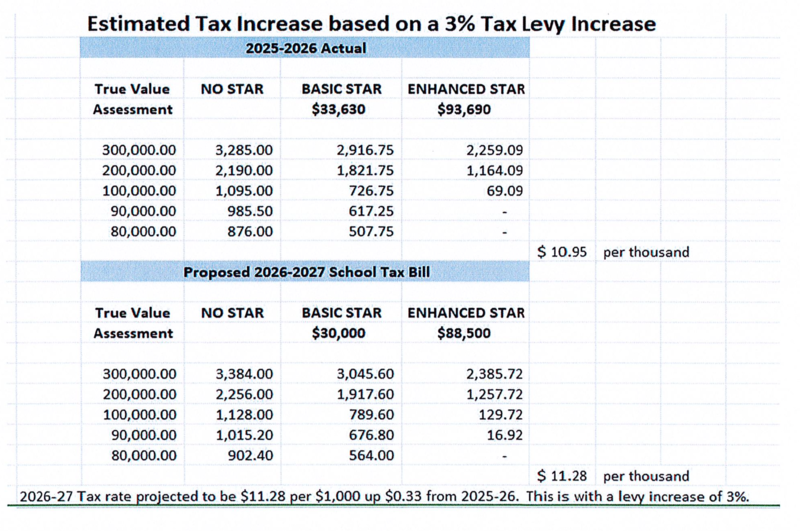
Looking ahead, the projected tax rate for 2026–2027 is $11.28 per $1,000, an increase of $0.33. For example, a homeowner with a property assessed at $100,000 would see an estimated increase of $33 per year in their school taxes if this rate is approved.
It’s important to note that a district’s tax rate directly affects how much each property owner pays, but it is separate from the total tax levy. The tax rate is influenced by a number of factors, including the total amount of money the district needs to raise (the levy), property assessments, and state equalization rates. Even with a modest increase in the tax rate, the impact on individual tax bills can vary from year to year depending on these variables.
While no tax increase is ever taken lightly, Attica has made a consistent effort to maintain a stable and comparatively lower tax rate while continuing to invest in the quality of education and services that benefit our students and community. The district remains committed to responsible financial stewardship and transparent communication with taxpayers.
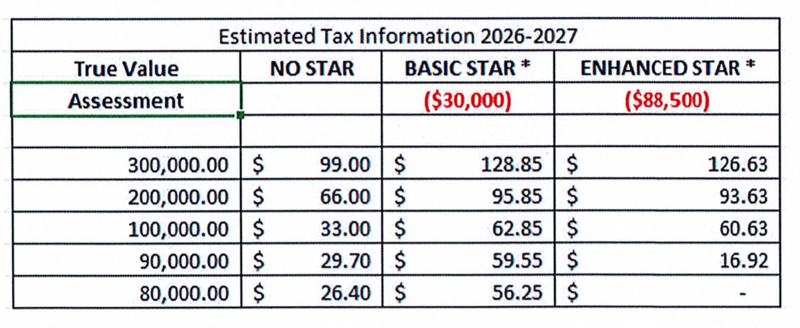
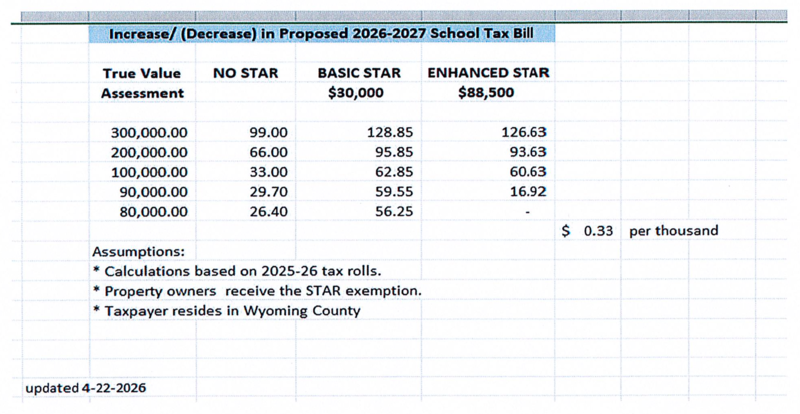
Please refer to the chart below to explain how this school budget would impact my taxes. I own a home assessed at $100,000. What would I pay with and without STAR exemptions?
Based on the estimated 2026-2027 tax information provided and assuming your township's equalization rate is 100%, the projected tax rate is $11.28 per $1,000 of assessed value—an increase of $0.33 from the previous year.
 Assumptions:
Calculations based on 2025-26 tax rolls.
* Per NYS Department of Tax and Finance as of 4-10-2026
How Will the Proposed Tax Levy Increase Impact My School Tax Bill?
The chart titled "Estimated Tax Information 2026-2027" shows how the proposed 2026–2027 tax levy increase may impact school tax bills based on your property’s assessed value and STAR exemption status.
The Basic and Enhanced STAR exemptions are calculated and certified by New York State each year. The exemption is not a fixed dollar amount from year to year, so it can fluctuate annually. This is why it may seem confusing or why you may see a larger increase or change on a school tax bill, even if your eligibility has not changed. As you will notice in the chart below the 25-26 School Year Basic and Enhanced STAR are much greater than in the 26-27 School Year.
I’m still confused about the increase in property assessments. How will this affect my school taxes?
It’s understandable to be concerned about changes in property assessments and how they will impact your school taxes. The key point to remember is that the school district does not determine property assessments.
Property assessments are done by your local town assessor, who evaluates the value of your property based on factors like market conditions, property improvements, and recent sales of similar homes in your area. These assessments are not set by the school district—they are determined at the local level.
Here’s how it works:
The assessed value of your property is used to calculate how much you will pay in taxes.
If your assessment increases, your tax bill may go up even if the school district’s tax rate stays the same.
If the assessed value decreases, your tax bill may go down, even if the district’s tax rate stays the same.
It’s also important to know that the school district’s budget and tax levy (the amount of money we need to raise from taxes) are separate from the assessments. The district sets its tax rate based on the total levy and the total value of all properties in the district. So, if property values increase overall, the district may be able to keep the tax rate the same, but your individual bill could still change depending on how your property’s assessment compares to others.
For more details on property assessments and how they affect your taxes, you can contact your local assessor’s office or visit the New York State Department of Taxation and Finance’s website for guidance on how assessments work.
Is the New York State STAR program still in effect?
Yes, the New York State School Tax Relief (STAR) program remains active and continues to provide valuable property tax relief to eligible homeowners across the state.
There are two types of STAR benefits:
Basic STAR: Available to homeowners with incomes of $500,000 or less.
Enhanced STAR: Designed for senior citizens (age 65 or older) with incomes of $110,750 or less.
Most new applicants now receive STAR as a credit, which comes in the form of a check from the New York State Department of Taxation and Finance. This credit can be used to offset your school tax bill. If you’ve been receiving the STAR exemption since before 2015, you may continue to receive it as a direct reduction on your school tax bill, provided you remain eligible
To apply for the STAR credit or to check your eligibility, visit the official New York State STAR registration page: https://www.tax.ny.gov/star
Who are the candidates running for the open Board of Education seats?
There are (7) individuals running for three (3) open seats on the Attica Central School District Board of Education. The election will be held on Tuesday, May 19, 2026, and voters may select up to (3) candidates on the ballot.
At the conclusion of the Public Budget Hearing on May 12, 2026, candidates will be given the opportunity to speak, should they choose to do so.
The candidates will appear on the ballot in the following order:
Ballot Line Candidate Name
Ballot 1 Pamela Rudolph
Ballot 2 Bridget Landphair
Ballot 3 Brian Fugle
Ballot 4 Michael Janes
Ballot 5 Christopher Kelver
Ballot 6 Anthony Dyrbala
Ballot 7 Susan Herman
The (3) candidates who receive the highest number of votes will be elected to serve on the Board of Education.
We encourage all district residents to vote and be part of the process that helps shape the future of our schools and students.